
How To Be Brave – Hull Truck Theatre – North West End UK
2 November 2024
The Godber Studio was very well-attended on Friday evening, when Hull Truck Theatre hosted How To Be Brave.
Writer Louise Beech cleverly intertwined the lives of the two main characters in this true-life drama – one a Merchant Seaman in the Second World War, the other a 10-year-old girl. And, despite the 64-year gap in their stories, the two had an undeniable connection.
The Able Seaman, Colin Armitage (Jacob Ward), was Beech’s grandfather, and the girl her daughter, Katy.
And it’s her storytelling to young Katy of Armitage’s horrific ordeal during the war that proved to be of huge benefit for her daughter, who had been diagnosed with Type 1 diabetes; helping her to accept and cope with her condition.
Five very talented performers brought How To Be Brave to life, on the small stage that clearly depicted both sides of the story – one side for Colin’s ordeal and the other for Katy’s.
Katy’s side is her home – soft toys, bean bag, books and dolls, while Colin’s is the life raft he spent 50 days in after his British cargo ship, the Lulworth Hill, was torpedoed by an Italian Navy submarine, in the South Atlantic just after midnight on March 19th, 1943.
The stage setting his side consisted of drapes of material, sides of a life raft, wooden crates and small metal containers containing provisions.
For Colin’s domain we had to use our imaginations somewhat, as he and his chum, carpenter Ken Cooke (Lex Stephenson), caught fish, rationed out the food and water, helped the 12 other survivors on the raft; also helping to bury them when they perished.
Although the two seamen’s name are true, Katy and her mum’s names are changed for this gripping story. Katy becomes Rose (Livy Potter) and Louise, Natalie (Alice Rose Palmer).

The play opens with the spotlight shining on Rose and her mum reacting to the news of Rose’s diabetes diagnosis.
Completing the cast is Alison Shaw as nurse Shelley, an invaluable aid to both mum and daughter.
As Natalie despairs of Rose’s stubbornness to accept the daily injections needed to stabilise her diabetes, Shelley’s well-meaning advice is not always readily accepted by mum or daughter.
However, when storytelling is mentioned as a distraction, and after several failed attempts to keep the 10-year-old from dying of boredom, story-wise, Natalie recounts the true saga of her grandfather’s bravery
This has the desired affect and pretty soon Rose is enduring the finger pricks and injections like a trouper.
As Natalie describes the daily horrors of her grandfather’s time in the life raft, Rose begins to come to terms with her own ordeal, declaring one day “If Grandad Colin can survive an ordeal like that, I can do anything. I can do these injections.” And to this day she has never faltered.
I mentioned there were two main characters in this story, but actually there is a third – Ken Cooke, who survived with Armitage.
It was Cooke who kept a log, written on sailcloth, that accurately described events.
In the fascinating programme there is the actual photograph, taken from the rescue ship HMS Rapid, showing Cooke and Armitage, the only two survivors, on their life raft.
All six actors played their part in keeping us enthralled. Ward and Stephenson as the two survivors, were so believable as they battled hunger, thirst and madness – not forgetting Scarface the shark.
Palmer as Rose’s mum so accurately displayed the angst of dealing with a stubborn child, while Potter’s 10-year-old Rose executed some of the most amusing lines to perfection.
And Shaw’s nurse had just the right amount of authority and compassion.
All voices could be clearly heard and at times you could hear a pin drop in the studio, so mesmerising were events on stage.
The song How To Be Brave, written and performed by Carrie Martin, added to the magic.
Beech’s clever script highlights two types of bravery – her grandfather’s during the Second World War, and her young daughters in the face of a serious illness. Her two stories seamlessly merged to bring us theatregoers a thought-provoking and unforgettable experience.
Running at Hull Truck Theatre until Saturday, November 2nd, 8pm. Visit www.otherlives.org.uk for details of performances at other venues up to November 16th, 2024.
Reviewer: Jackie Foottit
Reviewed: 1st November 2024
North West End UK Rating: ****
How to be Brave – Review
Wolfy O’Hare for Hull’s 107 FM
This is a review of ‘How to be Brave’ – a play by Louise Beech and directed
by Kate Veysey – playing at Hull Truck Theatre’s Godber Studio until
Saturday November 2. The play will be continuing its tour of the region
thereafter until Saturday 16 November. Details of the tour can be found at
Louise Beech’s website.
The play features an ensemble cast divided into those portraying present
and past events. Alice Rose Palmer, Livy Potter and Alison Shaw
portraying Natalie, Rose and the Diabetes Nurse, Shelley respectively in
the present – and Jacob Ward and Lex Stephenson playing Colin and Ken,
the shipmates cast into sea during the second world war.
It is a mark of a good play that everyday events very soon disappear into
the night air once the lights go down. The traffic on the way, the thoughts
that perennially interfere with peace of mind, such as which appliances
have been left to burn the house down on the way to the theatre – the
people who blindly step onto one’s feet in the foyer – all of these fade into
insignificance when a solid idea greets you on the stage.
‘How To Be Brave’ links two family situations in a parallel narrative. A
mother and daughter learning to cope with the latter’s diagnosis of type one
Diabetes – and the equally poignant story of the mother’s grandfather, Colin
and friend Ken, who with their unseen shipmates are adrift at sea following
a torpedo attack in the South Atlantic in 1943.
Past bravery inspires present resilience by means of motherly stealth and
storytelling – it is a compelling tale ably portrayed by the team of actors
involved. In the face of immense dangers a way must be found through –
and the play charts all of the harrowing stages through to redemption and
acceptance.
Danger is evoked through very simple means – more than once my feet
were raised from the floor at the portrayal of a shark attack (without an
actual shark, I might add) and in the case of the present story – one could
feel the anguish of a parent faced with the unthinkable: introducing their
child to a necessary (and painful) medical procedure while simultaneously
knowing that this must be framed as both care and a route to survival.
One of the most moving devices in the play has Rose and her great
grandfather meet in a shadow land of ‘no time’ in times of great crisis. The
usual and quotidian conventions of when and how dissolve in the need to
demonstrate that we can seize the resources of our past through the
tangible reality of our genetics – the past is with us, literally in the blood that
sustains our bodies.
This unsung magic is also our legacy – that who we become through our
experience and intrinsic qualities lies curled up like gunpowder in the coil of
our genetic code – the future we pass on to our children is indeed present in
who we truly are.
I urge you to see the play – it offers a whole gamut of emotions to be
experienced and cherished.
I was left with the feeling that if we are strengthened by the ghosts of our
past then it is also true that we are sustained by those from our future. The
magic resides in that they should somehow meet, embrace and thus fulfill
more than one destiny.
Wolfy O’Hare
How To Be Brave: Compelling
Julia Pattison
Theatre Correspondent
Yorkshire Times
Writer Louise Beech’s debut novel was How To Be Brave, published in 2015, a heartfelt tribute to her grandfather Colin Armitage, telling his sea survival story during WW2, while at the same time weaving in another storyline where Natalie and her nine-year-old daughter Rose struggle to come to terms with a Type 1 diabetes diagnosis that changed both their lives forever.
The book was a Guardian Readers’ Pick, and luckily for all of us, after Louise met up with freelance director Kate Veysey and Neil King and Richard Avery (founders of Other Lives Productions in 2006), she turned this book into the poignant and powerful play we were all privileged to experience at Theatre@41 on Sunday, 3rd November.
(L-R)Alice Palmer as Natalie and Livy Potter as Rose Photo: Other Lives Productions“We trade blood for words,” said Louise at the beginning of the play, through mother Natalie’s character (portrayed brilliantly by Alice Palmer). “This is our currency; her pain for my prose.” And so the story of bravery and determination to survive began.
The scenes alternated between the liferaft that Colin scrambled aboard after his ship was torpedoed in the South Atlantic in 1943 and Natalie and daughter Rose’s house in Hull. The story inspiring Rose to be brave in the face of her diabetes is a true one. When Louise’s daughter Katy received a Type 1 diabetes diagnosis 64 years after her grandfather Colin’s ordeal, she used the story of Colin’s bravery and determination to survive as a distraction for Katy during her insulin injections. Livy Potter was perfectly cast as nine-year-old Rose, capturing her fear, frustration, resentment, and anger with her diagnosis, taking it out on the one she loved most, her mother. The relationship created between mother and daughter really resonated, particularly the guilty feeling that haunted Natalie, even though she had nothing to blame herself for; this was raw, real life and made for powerful viewing, with the loving bond they had helping both of them sail through the choppy sea of emotions experienced. Alison Shaw made the part of nurse Shelley her own, flagging up what a vital role an empathetic nurse plays in the lives of patients coming to terms with being diagnosed with Type 1 diabetes.
The intimate space at Theatre @41 was ideal for Emily Clay’s carefully considered set design with atmospheric lighting (Leo McCall) working in perfect harmony with the script, creating a surreal yet totally believable time slip. Such was the quality of acting from this stellar cast. Credit too should be given to musician Carrie Martin for her haunting song, How To Be Brave, featured in the second half of the play.
HMS Rapid finally rescued Colin, along with the ship’s carpenter Ken “Chippie” Cooke, whom Colin had hauled from the water when the ship sank, 50 days after he scrambled aboard that liferaft. They were the only two survivors.
Louise is a master storyteller and cleverly drew parallels between Colin and Ken’s desperate situation and Rose’s, with the other men’s stories who had also reached the safety of the boat being told through mime and compelling narration; most effective drama devices. We suffered with all the crewmen as slowly but surely the days went by, always with the danger of life ebbing away—you could almost smell the fuel spillage that blackened Colin and Ken’s faces. So compelling was the drama unfolding before us, juxtaposed with Rose’s own battle to be brave.
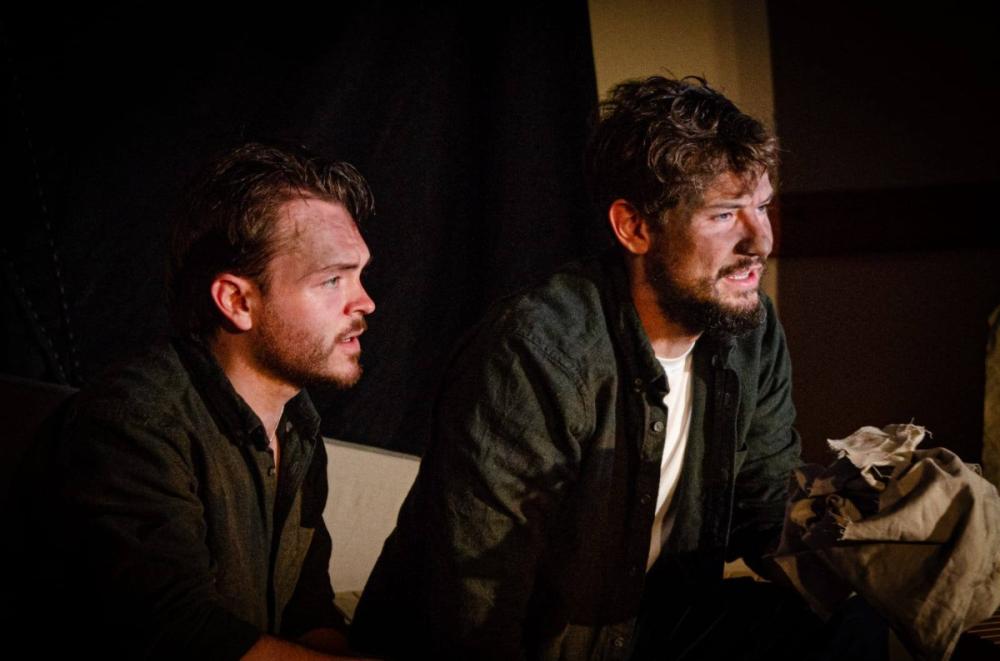
(L-R) Jacob Ward as Colin and Lex Stephenson as Ken Photo: Other Lives ProductionsJacob Ward was outstanding in his role of Colin Armitage, as was Lex Stephenson playing Ken Cooke; at times it was almost unbearable to watch their scenes at sea, all credit to how compelling and convincing they were as performers. You felt their fear too when “Scarface“ and other sharks became a real threat. We felt the tedium of their ordeal, yet the play was never tedious—far from it, just like Rose, we wanted to know the next chapter.
Louise never met her grandfather; he passed before she existed. However, she said that she fully believes that “memories are part of our make-up, passed on genetically, reliving somehow in our DNA. I’ve only read about him but smelt his presence between black-printed paragraphs.“
We most definitely felt his presence while experiencing this thought-provoking, inspiring play. Perfect timing before Remembrance Day. Lest We Forget.